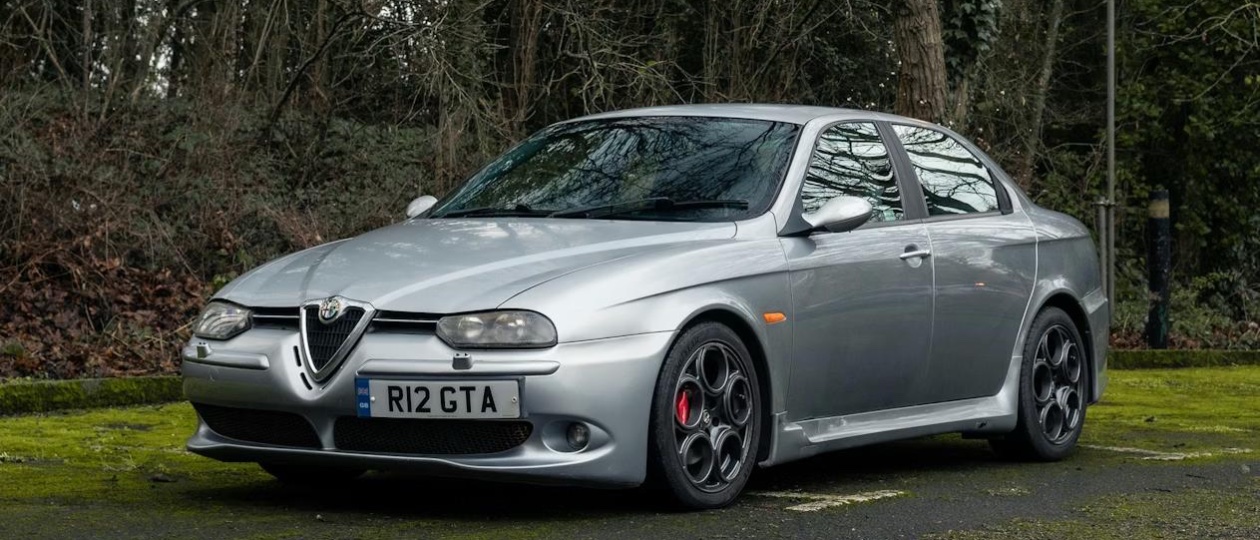
Alfa Romeo 156 GTA Buyer's Guide: The Enthusiast's Secret Weapon
alfa-romeo 156-gta · 2002–2005 · $15,000–$45,000
The Alfa Romeo 156 GTA is the most emotionally rewarding sport sedan of its era, a car that makes the E46 M3 feel clinical and the E39 M5 feel bloated, and its current obscurity represents the last genuine opportunity to buy a future classic before the market catches on.
History
You've never heard of this car. That's the point.
The Alfa Romeo 156 GTA arrived in 2002 as the performance flagship of Alfa's mid-size sedan range, and it did so with a weapon that no German competitor could match: the Busso V6. Named after Giuseppe Busso, the legendary Alfa Romeo engineer who designed the original V6 architecture in 1979, this 3.2-liter engine represents the absolute pinnacle of naturally aspirated Italian engineering -- a unit so sonically extraordinary that it makes the S54 in the BMW E46 M3 sound like a sewing machine by comparison.
The 156 itself had already earned its reputation as one of the most beautiful sedans ever drawn. Penned by Walter de'Silva at the Centro Stile Alfa Romeo, the original 156 won the European Car of the Year award in 1998 -- the first Alfa Romeo to receive the honor in decades. The design was revolutionary: hidden rear door handles integrated into the C-pillar, a bold triangular grille that referenced Alfa's racing heritage, and proportions that managed to look athletic without resorting to the aggressive styling cues that German manufacturers were already leaning into. Where the E46 M3 announced itself with flared fenders and a power dome hood, the 156 seduced with restraint.
The GTA designation itself carries enormous weight in Alfa Romeo's history. Gran Turismo Alleggerita -- Grand Touring Lightweight -- was first applied to the legendary 1965 Giulia Sprint GTA, a car that dominated European touring car racing for the better part of a decade. By 2002, the letters had been dormant for years, and Alfa chose to resurrect them for the most potent version of their most acclaimed sedan. This wasn't marketing cynicism -- the 156 GTA genuinely earned the name.
Under the hood sat the final evolution of the Busso V6, displacing 3.2 liters and producing 250 horsepower at 6,200 RPM and 221 lb-ft of torque at 4,800 RPM. These numbers look modest against the E46 M3's 333 horsepower, but they tell only part of the story. The Busso V6 delivers its power with a character that no inline-six, however refined, can replicate. The exhaust note transitions from a cultured burble at idle through a baritone growl in the midrange to a full-throated scream at the redline that has been described by automotive journalists as the single greatest sound ever produced by a production car engine. That's not hyperbole -- it's a widely held opinion among people who have driven both the GTA and its German contemporaries back to back.
The 156 GTA was never sold in the United States. This is both its greatest handicap and its most compelling investment thesis. While the E46 M3 saturated the American market with tens of thousands of units, the 156 GTA remained a European and Australian-market exclusive. Total production across the sedan and Sportwagon variants was approximately 6,000 units worldwide -- a fraction of the M3's volume. For American buyers, acquiring a 156 GTA means navigating the 25-year import rule, which began opening the door for 2002 models in 2027. The earliest cars are nearly eligible, and demand from American enthusiasts who have heard the Busso V6 on YouTube but never driven one is building steadily.
The car competed in the European Touring Car Championship and various national touring car series, where it proved that Alfa Romeo's racing DNA hadn't been diluted by decades of Fiat ownership. Factory-supported teams campaigned the 156 GTA extensively, and the car's motorsport pedigree is genuine -- not the retroactive marketing exercise that some manufacturers apply to their performance models.
Production ended in 2005 when the 156 was replaced by the 159, which used a corporate GM-derived V6 that was competent but soulless. The Busso V6 died with the 156 GTA and its sibling, the 147 GTA. It was the last Alfa Romeo engine designed by Busso himself, and the last expression of a design philosophy that prioritized character over efficiency. Every Alfa Romeo V6 since has been a lesser thing.
Variants
156 GTA Sedan (2002-2005)
The sedan is the definitive 156 GTA -- the car that de'Silva designed and Alfa Romeo intended as the platform's ultimate expression. It weighs approximately 3,150 pounds, carries the 3.2-liter Busso V6 mated exclusively to a six-speed manual transmission (Alfa offered a Selespeed automated manual on lesser 156 models, but wisely kept it away from the GTA), and rides on a sport-tuned suspension with stiffer springs, revised damping, and larger anti-roll bars compared to the standard 156.
The sedan's weight distribution is close to 60/40 front-to-rear -- the inevitable consequence of a transversely mounted V6 driving the front wheels. Yes, the 156 GTA is front-wheel drive. This is the fact that causes BMW devotees to dismiss it without a test drive, and it's the fact that makes the car's dynamic accomplishments all the more remarkable. Alfa Romeo's engineers invested enormous effort in the front suspension geometry, using a sophisticated double-wishbone setup with carefully calibrated anti-dive and anti-squat characteristics. The result is a front-wheel-drive car that manages its 250 horsepower with surprisingly little torque steer under most conditions, and that communicates the state of front tire grip through the steering wheel with a transparency that many rear-drive cars fail to achieve.
The interior features sport seats with aggressive bolstering, an aluminum-trimmed center console, and Alfa's characteristically idiosyncratic switchgear. The gauge cluster is a work of art -- deeply hooded and angled toward the driver in a way that makes the BMW E46 M3's instrument panel look like it was designed by an accountant. Everything in the GTA's cockpit prioritizes the driver's relationship with the machine over ergonomic convention.
156 GTA Sportwagon (2002-2005)
The Sportwagon is the 156 GTA for people who understand that practicality and passion are not mutually exclusive. Mechanically identical to the sedan -- same 3.2-liter Busso V6, same six-speed manual, same sport suspension -- the Sportwagon adds a proper estate rear end that transforms the car from a four-door sport sedan into something rarer and more desirable: a genuinely fast wagon.
The Sportwagon weighs approximately 100 pounds more than the sedan, and the additional rear overhang slightly shifts the weight distribution further forward. In practice, the dynamic differences between the two body styles are negligible. What the Sportwagon gains is an enormous amount of cargo capacity and an aesthetic presence that is, to many enthusiasts, even more compelling than the sedan. A silver 156 GTA Sportwagon on a set of period-correct multi-spoke wheels is one of the most beautiful cars of the 2000s, full stop.
Production numbers for the Sportwagon were significantly lower than the sedan -- estimates suggest roughly 2,000 units across all markets. This rarity, combined with the inherent desirability of fast wagons among the enthusiast community, means clean Sportwagons command a modest but consistent premium over equivalent sedans.
Model Year Differences
The 156 GTA underwent minimal changes during its four-year production run. The most notable revision came in 2003, when Alfa Romeo revised the engine management software to improve emissions compliance without altering peak power figures. Some owners report a slightly different throttle response on post-2003 cars, though whether this is perceptible or psychological is debated. Late-production 2005 models occasionally feature minor interior material changes as Alfa began winding down the 156 platform.
Common Issues
Timing Variator (Camshaft Phaser)
This is the 156 GTA's most significant mechanical vulnerability. The Busso V6 uses hydraulic camshaft variators to adjust valve timing, and these units wear over time, producing a distinctive rattle on cold starts that persists for several seconds before oil pressure stabilizes the system. A rattling variator is not immediately dangerous -- the engine will run normally once warm -- but a failed variator can skip timing and cause valve-to-piston contact. Replacement is a labor-intensive job that requires removing the intake manifold and costs $1,500-$2,500 at a specialist shop. Always listen for variator rattle during a cold-start inspection. If present, budget for the repair and factor it into your purchase price.
Thermostat Housing and Cooling System
The 156 GTA's cooling system uses a plastic thermostat housing that becomes brittle with age and thermal cycling. Failure typically manifests as a coolant leak at the housing, which can progress to overheating if undetected. The fix is straightforward -- replace the housing with an OEM or aftermarket unit -- but access is poor on the transverse V6, making it a 3-4 hour job. While you're in there, replace the thermostat itself and inspect all coolant hoses. The water pump is driven by the timing belt (yes, the Busso V6 uses a belt, not a chain) and should be replaced at every belt service interval.
Timing Belt Service
The Busso V6's timing belt requires replacement every 36,000 miles or 3 years, whichever comes first. This is an absolute, non-negotiable maintenance item. A snapped timing belt on the interference Busso V6 means catastrophic engine damage. The service includes the belt, tensioner, idler pulleys, and ideally the water pump, and costs $800-$1,500 at an Alfa specialist. If a seller cannot document the timing belt service history, assume it needs doing immediately and price accordingly.
Selespeed Actuator (Not Applicable to GTA)
While the standard 156 range suffered extensively from Selespeed automated manual transmission failures, the GTA was exclusively offered with a conventional six-speed manual. This single fact eliminates what was arguably the most expensive and frustrating failure mode on lesser 156 models. The GTA's manual gearbox is robust, with well-spaced ratios and a precise shift action that rewards attentive inputs.
Electrical Gremlins
Italian electrical engineering of the early 2000s has a reputation, and the 156 GTA does not entirely escape it. Window regulators, door lock actuators, and dashboard warning lights that illuminate without apparent cause are common complaints. None of these issues are mechanically serious, but they require an owner with patience and a tolerance for automotive character. The instrument cluster itself can develop pixel dropout on the LCD display, a repair that specialists can perform for $200-$400.
Rust
The 156 was built during a period when Fiat Group's corrosion protection was improving but not yet world-class. European-market cars, particularly those from northern climates, can exhibit rust in the rear wheel arches, sill panels, and around the rear subframe mounting points. A thorough underbody inspection is essential on any prospective purchase. Australian-market cars tend to fare better due to the drier climate but should still be checked. Structural rust on a 156 GTA is a walk-away condition -- the repair costs will exceed the car's value.
Pricing Analysis
The 156 GTA occupies a peculiar position in the enthusiast market: it is simultaneously undervalued relative to its driving experience and overvalued relative to the public's awareness of its existence. In practical terms, this means you can buy one of the most emotionally compelling sport sedans of the 2000s for a fraction of what a comparable BMW E46 M3 or BMW E39 M5 commands.
Current Market Ranges (2026)
156 GTA Sedan:
- Project/high-mileage (150,000+ km): $12,000-$18,000
- Driver-quality (80,000-130,000 km): $20,000-$30,000
- Excellent condition (under 60,000 km): $32,000-$42,000
- Concours/low-mileage museum pieces: $40,000-$50,000
156 GTA Sportwagon:
- Add approximately 10-15% premium across all condition categories
- Clean, low-mileage Sportwagons occasionally exceed $50,000 at specialist auctions
Market Trajectory
The 156 GTA's market trajectory is approximately 5-7 years behind the E46 M3's price curve. When M3 prices were in the $15,000-$25,000 range (circa 2016-2018), nobody was paying attention. Now clean E46 M3s routinely sell for $40,000-$70,000. The 156 GTA is entering the early appreciation phase, driven by several converging factors: the 25-year US import eligibility window opening for 2002 models, growing YouTube and social media exposure of the Busso V6 sound, and the broader market recognition that distinctive, low-production European sport sedans from this era are a finite resource.
The investment thesis is simple. You can buy a 156 GTA today for less than the price of a base-model E46 M3. The Alfa is rarer (6,000 units versus 85,000+ M3s), more distinctive, and offers a driving experience that many enthusiasts who have sampled both prefer. The risk is parts availability and the narrower buyer pool when you eventually sell. The reward is owning a car that will likely double in value over the next decade while providing a driving experience that no amount of money can buy new.
This is the pick that separates the enthusiasts from the speculators. If you want a safe investment, buy the M3. If you want the car that makes you pull over at the end of a mountain road just to listen to the engine tick as it cools, buy the 156 GTA.
Where to Buy
The European market is the primary hunting ground, with Italy, Germany, the UK (right-hand-drive models), and Australia offering the largest pools of surviving cars. Bring a Trailer and Cars & Bids see occasional listings as early 25-year-eligible cars begin arriving in the US. Specialist Alfa Romeo dealers in the UK and Germany maintain curated inventories of GTA models, and their pre-sale inspection standards typically exceed what you'd find through private sale channels.
Inspection Checklist
Inspecting a 156 GTA requires a different mindset than shopping for a German sport sedan. The car's strengths are emotional and mechanical; its weaknesses are electrical and structural. Here's what to evaluate:
Pre-Visit Research
- Service history documentation: This is the single most important factor in 156 GTA evaluation. A complete service history from Alfa Romeo dealers or recognized specialists dramatically increases a car's value and reduces your risk. The timing belt service records are critical -- if undocumented, assume the belt needs immediate replacement.
- Ownership history: Low-owner cars with documented provenance command significant premiums and are worth the extra investment.
Cold Start Assessment
- Timing variator rattle: Arrive unannounced if possible, or ask the seller to leave the car cold. Start the engine and listen for rattling from the front of the engine during the first 15-30 seconds. Brief rattle that disappears as oil pressure builds is the variator showing wear -- negotiate accordingly. Persistent rattle is a more serious concern.
- Idle quality: The Busso V6 should idle smoothly at approximately 800 RPM with no hunting or surging. Irregular idle can indicate vacuum leaks, failing idle control valve, or fueling issues.
- Exhaust smoke: Brief white smoke on a cold start is normal condensation. Blue smoke indicates oil consumption from valve stem seals -- a common issue on high-mileage Busso engines that costs $2,000-$3,000 to address.
Driving Evaluation
- Steering feel: The 156 GTA uses hydraulic power steering that should be communicative and progressive. Heavy spots, whining from the power steering pump, or vague center feel indicate pump wear or rack issues.
- Gearbox operation: Run through all six gears under load. The shift action should be precise with moderate effort. Notchy or resistant engagement in any gear suggests synchro wear. Second and third are most commonly affected.
- Brake performance: The 156 GTA uses Brembo brakes as standard. Pedal feel should be firm with strong initial bite. Pulsation indicates warped rotors -- a straightforward fix but a negotiation point.
- Torque steer assessment: Under hard acceleration from a standstill, some steering wheel tug is normal given 250 horsepower through the front wheels. Excessive or asymmetric pull suggests worn engine mounts or suspension components.
Underbody and Structure
- Rust inspection: Check rear wheel arches, sill panels, front subframe mounts, and the area around the rear trailing arm bushings. Surface rust is manageable. Structural perforation is a deal-breaker.
- Fluid leaks: Inspect the engine bay from below for oil leaks around the valve covers, oil pan, and timing cover. Minor seepage is typical of a 20-year-old Italian engine. Active dripping requires investigation.
- Suspension bushings: Press firmly on each corner of the car and listen for creaks. Clunking over bumps during the test drive indicates worn bushings -- budget $500-$1,000 for a comprehensive bushing refresh.
Maintenance Guide
Maintaining a 156 GTA is more demanding than maintaining an E46 M3 or an S2000, and it requires either mechanical aptitude or a relationship with a specialist shop. This is not a car for owners who service their vehicles at franchise quick-lube operations. That said, the Busso V6 is fundamentally robust when properly maintained, and the mechanical complexity is manageable for an experienced home mechanic with a good workshop manual.
Engine Oil
The Busso V6 is particular about its oil. Use a quality 10W-60 fully synthetic oil -- Selenia Racing or Motul 300V are the enthusiast community's preferred choices. Change intervals should not exceed 6,000 miles or 12 months, and 4,000-mile intervals are preferable for cars driven enthusiastically. The Busso's plain bearings and tight tolerances reward fresh oil with smooth operation and longevity. Capacity is approximately 6.5 quarts including filter.
Timing Belt
This is the single most critical maintenance item. The Busso V6 is an interference engine, and belt failure means catastrophic valve damage that will cost more to repair than many 156 GTAs are worth. Replace the timing belt, tensioner, and idler pulleys every 36,000 miles or 3 years. Replace the water pump at every other belt service (72,000-mile intervals). A comprehensive timing belt service including water pump runs $800-$1,500 at a specialist. This is not the place to economize.
Timing Variators
The camshaft variators should be inspected at every timing belt service. If cold-start rattle is present, replace them proactively. New variators cost $300-$500 per pair, and the labor is already partially accounted for if done during a belt service. Waiting until a variator fails catastrophically transforms a $2,000 service into a $6,000+ engine rebuild.
Cooling System
Replace coolant every 2 years or 24,000 miles with Alfa Romeo-specification antifreeze. Inspect the thermostat housing for cracks at every service -- the plastic housing is a known failure point. Replace all coolant hoses at 10 years or any time they show signs of swelling, hardening, or weeping. The radiator should be inspected for fin corrosion and end-tank leaks, particularly on cars over 15 years old.
Brakes
The Brembo brake system is excellent but requires quality consumables. Use name-brand pads (Brembo, EBC, or Ferodo) and replace rotors when they reach minimum thickness -- do not machine them. The 156 GTA's brakes are adequately sized for spirited road driving but will overheat during extended track use. Brake fluid should be flushed every 2 years with DOT 4 specification fluid.
Clutch
The six-speed manual's clutch is a durable unit under normal driving but can wear prematurely if the car is used extensively in heavy traffic -- the combination of a heavy flywheel and 250 horsepower through the front wheels makes stop-and-go driving harder on the clutch than in lighter, rear-drive cars. Clutch replacement including flywheel inspection and resurfacing costs $1,200-$2,000 at a specialist. Budget for this at 80,000-100,000 miles.
Parts Sourcing
This is where 156 GTA ownership diverges most sharply from German and Japanese alternatives. Common service items -- filters, brake pads, belts, fluids -- are readily available through standard parts suppliers and RockAuto. However, body panels, interior trim, electrical components, and GTA-specific mechanical parts require sourcing from European Alfa Romeo specialists or dismantlers. The UK-based Alfa Romeo parts community is particularly well-organized, with specialists like Alfa Aid and Highwood Technology maintaining extensive inventories. Online forums and Facebook groups are essential resources for locating rare parts.
Be honest with yourself before buying: if you need your car fixed at any dealership within driving distance, the 156 GTA is not for you. If you're willing to develop a relationship with a specialist, source parts internationally, and occasionally wait a week for a component to arrive from Italy, the ownership experience is deeply rewarding in a way that running a parts-bin BMW simply cannot replicate.
Insurance
Insurance for a 156 GTA is a nuanced proposition that reflects the car's unusual market position: it's too obscure for most standard insurers to value correctly, too rare for conventional replacement if totaled, and too characterful to insure as just another 20-year-old sedan.
The Valuation Problem
Standard auto insurance companies will attempt to value your 156 GTA using database comparables, and they will get it catastrophically wrong. Their systems see "2003 Alfa Romeo 156" and return a value based on depreciation curves for mass-market European sedans -- typically $3,000-$8,000. Your car is worth $25,000-$45,000. This gap is not a negotiation -- it's a fundamental misunderstanding of the asset class. If you insure a 156 GTA through a standard carrier and suffer a total loss, you will receive a check that covers perhaps 20% of what you need to replace the car.
Specialty Insurers
Agreed-value policies through specialty insurers are not optional for 156 GTA ownership -- they are mandatory. These policies establish a guaranteed payout value upfront, backed by appraisal documentation, and ensure you can replace your car if the worst happens.
Hagerty understands the 156 GTA market and actively tracks values for European performance cars of this era. Their agreed-value policies for a $30,000-$40,000 GTA typically run $600-$1,200 per year depending on annual mileage, storage conditions, and your driving record. Hagerty's familiarity with the marque means you won't spend hours explaining to an adjuster why your Alfa Romeo is worth more than a used Camry.
American Collectors offers competitive agreed-value coverage and tends to be more flexible on daily driver restrictions. For US-based owners who plan to use their imported GTA regularly, American Collectors may offer a better fit than Hagerty's more traditional collector-car usage limitations. Premiums are typically comparable to Hagerty's, with slightly more generous mileage allowances.
US Import Considerations
For American buyers importing 156 GTAs under the 25-year rule (2002 models eligible from 2027), insurance procurement should begin during the import process, not after. Some specialty insurers will bind coverage on an imported vehicle before it clears customs, provided you have the import documentation and an independent appraisal. Others require the car to be titled and registered in the US before issuing a policy. Clarify this with your insurer early -- you don't want your $35,000 car sitting uninsured in a bonded warehouse while paperwork processes.
Insurance Strategy
Given the 156 GTA's limited US presence and the complexity of sourcing replacement parts, your insurance policy should include the following considerations:
- Agreed value set at current market replacement cost, reviewed annually as the market evolves
- Spare parts coverage if you maintain an inventory of hard-to-find components (some policies offer this as a rider)
- Overseas transit coverage if you're importing the car or shipping it for specialty service
- Roadside assistance through a provider familiar with European vehicles -- standard AAA providers may not know how to handle an Alfa Romeo's quirks
The bottom line: specialty insurance is the single most important administrative step in 156 GTA ownership. The premium differential between a standard policy and an agreed-value specialty policy is a few hundred dollars per year. The payout differential in a total loss scenario is tens of thousands of dollars. This is not the place to economize. Treat it as part of the purchase price and budget accordingly.
Insure Your 156-gta
Agreed-value policies are essential for appreciating classics. Lock in today's value before the market moves.
Find Your 156-gta
Browse current listings and recently sold examples to find the right one at the right price.
Parts & Maintenance
Keep your 156-gta running strong with OEM and quality aftermarket parts.
Recommended Tools
Our curated list of tools for 156-gta owners -- from basic maintenance to weekend wrenching.
Need advice on this car?
Chat with us on WhatsApp — get the Pre-Purchase Inspection Checklist, ask about pricing, or tell us about yours.
Chat with us on WhatsApp