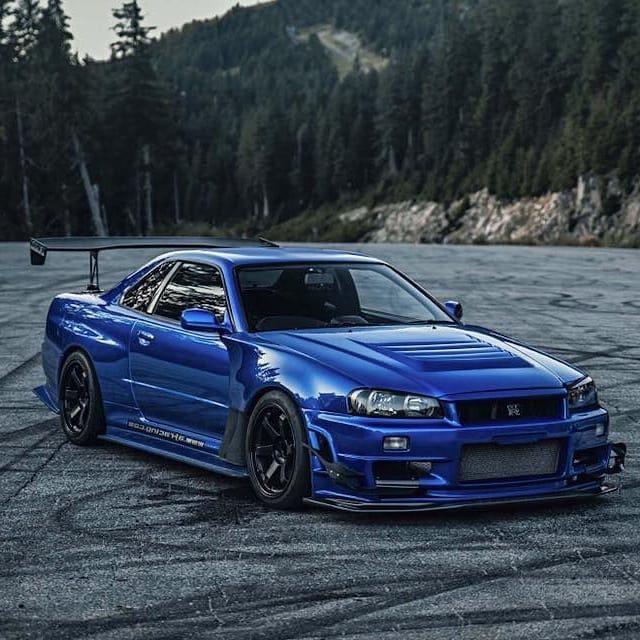
Nissan R34 Skyline GT-R Buyer's Guide: The Last of the Pure-Bred Godzillas
nissan r34-skyline-gt-r · 1999–2002 · $120,000–$500,000
The Nissan R34 Skyline GT-R is the last car ever built with the RB26DETT and the final expression of a lineage that defined Japanese performance engineering -- a future classic whose values reflect its status as the rarest, most refined, and most culturally significant GT-R ever produced.
History
The Nissan Skyline GT-R R34 is the car that Nissan knew would be its last. When the BNR34 launched in January 1999, Nissan was already deep into the corporate restructuring that would bring Carlos Ghosn and the Renault alliance to Yokohama. The GT-R program, a money-losing halo project that existed to win races and project engineering dominance, was living on borrowed time. What Nissan's engineers produced in those final years was not a car designed by committee or compromised by cost-cutting. It was the most refined, most technologically advanced, and most focused GT-R ever built -- the perfected culmination of a lineage that began with the R32 in 1989 and defined what a Japanese supercar could be.
The R34's story begins with its engine, the RB26DETT. This 2.6-liter twin-turbocharged inline-six was not new to the R34 -- it had powered every GT-R since the R32 -- but by 1999, Nissan had refined it to its ultimate production specification. The iron-block, aluminum-head engine used individual throttle bodies for each cylinder, a design choice borrowed from racing that gave the RB26 throttle response that felt more like a naturally aspirated engine than a turbocharged one. The twin ceramic turbochargers operated in parallel (not sequentially, like the Toyota Supra MK4 or Mazda RX-7 FD), each feeding three cylinders for symmetrical boost delivery.
Under the gentleman's agreement that bound Japanese automakers, the R34 GT-R was officially rated at 280 PS (276 horsepower). Nobody believed this number. Independent dyno testing consistently showed 320-330 horsepower at the wheels, implying a true crank output closer to 340 horsepower. The gap between the official rating and actual output was an open secret -- Nissan built a 340-horsepower car and stamped 280 on the spec sheet because that was the agreement.
But the engine was only one element of the R34's engineering package. The real genius was in the chassis systems. ATTESA E-TS Pro, Nissan's electronically controlled all-wheel-drive system, used an electromagnetic multi-plate clutch to distribute torque between the front and rear axles. In normal driving, the R34 was essentially rear-wheel-drive. Under acceleration, cornering load, or loss of traction, the system could transfer up to 50% of torque to the front axle in milliseconds. An active limited-slip differential at the rear used the same electromagnetic clutch technology to manage torque distribution between the rear wheels. The result was a car that could put 340 horsepower to the ground with surgical precision in conditions that would overwhelm a rear-wheel-drive car of similar power.
The Super-HICAS four-wheel steering system added another layer of chassis intelligence. At low speeds, the rear wheels turned opposite to the fronts, tightening the turning radius. At high speeds, they turned in the same direction, adding stability during lane changes and high-speed direction changes. Critics -- and there were many -- argued that HICAS introduced an artificial, slightly disconnected quality to the steering feel compared to a fixed-rear-steering car. They weren't wrong. But at the limit, on track, HICAS gave the R34 cornering capabilities that defied its 3,500-pound curb weight.
The R34 was the first GT-R to feature the Multi-Function Display (MFD), a 5.8-inch LCD screen mounted on the center console that showed real-time data including boost pressure, oil temperature, turbo speed, and G-force readings. In 1999, this was extraordinary -- a factory-installed performance telemetry system years before similar technology appeared in European sports cars. The MFD also displayed rear-view camera footage, making the R34 one of the first production cars in the world to offer a reversing camera.
Nissan produced approximately 11,577 R34 GT-Rs across all variants from 1999 to 2002. The car was never officially sold in the United States, Europe, or most markets outside Japan. This rarity, combined with the 25-year import rule in the US (which began allowing 1999 models in 2024), has created a market dynamic where demand dramatically exceeds supply. The R34 GT-R is not just a future classic -- it is already one of the most valuable Japanese performance cars ever produced, with exceptional examples trading above half a million dollars.
The R34's cultural significance compounds its collector value. Like the Supra MK4, the R34 was immortalized in the Fast & Furious franchise -- Paul Walker's blue R34 in 2 Fast 2 Furious became an icon. But the R34's cultural presence extends deeper: it was the definitive hero car of the Gran Turismo video game series, the crown jewel of the Japanese drifting and time attack scenes, and the car that an entire generation of enthusiasts grew up dreaming about but could never legally own. Now that the 25-year import window has opened, that pent-up demand is meeting a supply of fewer than 12,000 cars worldwide. The economics are as inevitable as they are dramatic.
Variants
GT-R Standard (BNR34)
The base GT-R established a remarkably high floor. The RB26DETT twin-turbo inline-six, ATTESA E-TS Pro all-wheel-drive, six-speed Getrag manual transmission, Brembo brakes, active rear LSD, and the Multi-Function Display were all standard equipment. The standard GT-R used a conventional steel hood and lacked the carbon fiber and aerodynamic enhancements of the V-Spec models. In the current market, the standard GT-R represents the entry point to R34 GT-R ownership, though "entry point" is a relative term when clean examples start above $150,000.
GT-R V-Spec (BNR34)
The V-Spec -- "Victory Specification" -- was the core performance variant and the car most enthusiasts picture when they think of the R34 GT-R. Over the standard car, the V-Spec added a carbon fiber hood, front lip spoiler, carbon fiber rear diffuser, stiffer springs, firmer dampers, and the ATTESA E-TS Pro system with an upgraded active rear LSD controller. The suspension was lowered by 10mm front and rear. Brembo brakes were standard across both variants, but the V-Spec received slightly more aggressive pad compounds. The V-Spec is the volume seller of the R34 GT-R range and the most commonly available variant on the market today.
GT-R V-Spec II (BNR34)
Introduced in late 2000, the V-Spec II was an evolution rather than a revolution. The headline upgrade was the addition of a carbon fiber roof panel -- a genuine structural component that reduced the car's center of gravity and shaved approximately 6 pounds from the highest point of the chassis. The V-Spec II also received revised N1 water pump and oil pump specifications, improved intercooler piping, and gold-finished BBS wheels that became the car's most recognizable visual signature. The V-Spec II is the variant that most collectors target: it has all the performance upgrades of the V-Spec plus the carbon roof and the cachet of the later, more refined production run.
GT-R M-Spec (BNR34)
The M-Spec -- named for Motoharu Kurosawa, the engineer who oversaw the GT-R program -- was Nissan's attempt at a luxury-oriented GT-R. It featured softer Ripple Control dampers, a leather-trimmed interior with heated front seats, and a more compliant ride quality. The M-Spec shared the V-Spec II's carbon fiber hood but used a steel roof, making it slightly heavier. Only 285 M-Spec cars were produced, making it one of the rarer R34 variants. The M-Spec occupies an unusual market position: it's rarer than the V-Spec II but less desirable among performance purists, which means its premium over a standard V-Spec is smaller than the production numbers might suggest.
GT-R Nur (BNR34)
Named after the Nurburgring -- where the R34 GT-R set a production car lap record of 7 minutes 52 seconds -- the Nur specification was a final-edition run produced in 2002. The Nur received the N1-specification RB26DETT engine, which featured a balanced and blueprinted bottom end, stronger pistons, upgraded oil jets, and a revised turbine housing design. The Nur also came with gold-finished BBS wheels, a unique purple-tinted gauge cluster, and a commemorative plaque. Only 750 Nur models were produced (including V-Spec II Nur), making any Nur-badged R34 exceptionally scarce.
GT-R V-Spec II Nur (BNR34)
The rarest and most valuable R34 GT-R of all. The V-Spec II Nur combined the V-Spec II's carbon fiber roof, uprated chassis, and aggressive aerodynamics with the Nur's N1-specification engine. Only 718 of the combined Nur allocation received V-Spec II specification. In the current market, a clean V-Spec II Nur in Bayside Blue or Millennium Jade commands prices well above $350,000, with exceptional examples exceeding $500,000. This is the variant that auction houses build entire sale events around.
Common Issues
RB26DETT Oil System
The RB26DETT is one of the most robust engines in the Japanese performance canon, but it has a known weakness: oil starvation under sustained high-G cornering. The stock oil pan design allows oil to slosh away from the pickup during hard left-hand turns (right-hand turns in JDM right-hand-drive configuration), causing momentary oil pressure loss. On the street, this is irrelevant. On track, it's a catastrophic engine failure waiting to happen.
Any R34 GT-R that has been used on track should have either a baffled oil pan or a dry sump conversion. Inspect the underside for oil pan modifications and ask specifically about track history. A well-maintained RB26 that has never been oil-starved will run for 200,000+ miles. One that has experienced even a few seconds of sustained oil starvation may have bearing damage that manifests as knock under load.
Ceramic Turbos
All R34 GT-Rs (except the Nur and N1 models) used ceramic turbine wheels in the twin turbochargers. Ceramic turbos spool faster and reduce turbo lag, which is why Nissan used them. The problem is fragility: ceramic turbine wheels can shatter under extreme heat or boost spikes, sending shrapnel through the engine. This failure mode is rare under stock boost conditions but becomes increasingly likely as boost pressure increases.
Most modified R34s have already had their ceramic turbos replaced with steel-wheel equivalents. If you're buying a stock or lightly modified car with original turbos, they're perfectly fine for normal driving -- but budget for a steel turbo conversion ($3,000-$5,000) if you plan any power modifications beyond a boost controller.
ATTESA E-TS Pump and Hoses
The all-wheel-drive system relies on a hydraulic pump and a network of high-pressure hoses to actuate the front transfer case clutch. These hoses are original rubber and deteriorate with age. A failing ATTESA hose causes gradual loss of front-axle engagement, and a complete hose failure results in a rear-wheel-drive-only car. The pump itself is durable, but it works harder with degraded hoses and can overheat.
Replacement ATTESA hoses are available from Nissan and aftermarket suppliers for approximately $300-$500 for the full set. The labor is moderate -- approximately 4-6 hours at a specialist shop. This is a mandatory maintenance item for any R34 GT-R over 15 years old that hasn't already had the hoses replaced.
HICAS Steering System
Super-HICAS four-wheel steering is the R34's most controversial system. When working correctly, it adds stability and agility. When failing, it introduces terrifying unpredictability to the rear end. Common HICAS failures include leaking power steering fluid from the rear steering rack, sensor failures that cause erratic rear steering inputs, and pump failures that default the system to a centered position.
Many enthusiasts delete HICAS entirely using a lockout kit ($150-$300), which fixes the rear wheels in the straight-ahead position. This eliminates all HICAS-related failure modes and simplifies the steering system. The tradeoff is slightly wider turning radius and the loss of high-speed stability assistance. Most track-focused R34 owners delete HICAS; most street-oriented collectors keep it functional.
Import and Documentation Risks
Because the R34 was never sold in the US, every R34 in America is an import. The 25-year rule requires cars to be at least 25 years old from date of manufacture to be legally imported. The 1999 model year R34s became eligible in 2024, with subsequent years becoming eligible annually through 2027.
The critical documentation to verify: original Japanese export certificate, US Customs entry paperwork (HS-7), EPA exemption (over 21 years old at time of import), NHTSA importation eligibility letter, and state title and registration. Any car without this complete documentation chain is a potential seizure risk -- US Customs and Border Protection has confiscated illegally imported R34s and crushed them.
Odometer fraud is the other major documentation concern. Japanese domestic market odometers use kilometers, and the temptation to roll back a high-kilometer example before export is significant. Verify the odometer reading against the Japanese auction sheet (if the car went through auction), the export certificate, and any available maintenance records. A 150,000-kilometer R34 presented as a 50,000-kilometer car is a fraud that costs the buyer $50,000-$100,000 in overpayment.
Rust
Japanese domestic market cars are exposed to significant road salt in northern regions and coastal humidity everywhere. The R34's primary rust areas are the rear wheel arches, the trunk floor (around the battery tray), the front subframe mounting points, the lower door skins, and the area around the rear window seal. Inspect these areas carefully with a flashlight and a magnet (to detect body filler). Any R34 that spent its life in Hokkaido or northern Honshu needs particularly thorough underbody inspection.
Pricing Analysis
The R34 Skyline GT-R market is the most extreme example of supply-demand dynamics in the modern collector car world. Approximately 11,577 GT-Rs were produced over four model years. A significant number have been crashed, modified beyond recovery, rusted out, or exported to countries where they'll never return. The available supply for the global collector market is probably under 8,000 cars -- and declining annually.
Current Market Ranges (2026)
GT-R Standard:
- High-mileage/project: $100,000-$130,000
- Driver-quality (100,000+ km): $130,000-$170,000
- Clean (50,000-100,000 km): $170,000-$220,000
GT-R V-Spec:
- High-mileage/project: $130,000-$160,000
- Driver-quality: $160,000-$210,000
- Clean: $210,000-$280,000
GT-R V-Spec II:
- Driver-quality: $200,000-$260,000
- Clean: $260,000-$350,000
- Low-mileage: $350,000-$420,000
GT-R M-Spec:
- Driver-quality: $200,000-$280,000
- Clean: $280,000-$380,000
GT-R Nur / V-Spec II Nur:
- Driver-quality: $300,000-$400,000
- Clean: $400,000-$550,000
- Exceptional/low-mileage: $550,000+
Color Premiums
Bayside Blue (TV2) is the R34's signature color and commands a 10-15% premium over equivalent cars in other colors. Millennium Jade (J1), a limited-edition color exclusive to certain V-Spec II and Nur models, commands a 15-25% premium. White Pearl (QM1) and Midnight Purple III (LX0) also carry modest premiums. Silica Breath (WV2) and Athlete Silver (KR4) are the most common colors and trade at market average.
Market Trajectory
The R34 GT-R is no longer a speculative future classic -- it's a present-tense blue-chip collector car. The opening of the 25-year import window for 1999 models in 2024 triggered a brief price correction as supply entered the US market, followed by continued appreciation as that initial wave was absorbed by pent-up demand.
The structural fundamentals support continued long-term appreciation. Supply is fixed and declining. Demand is global and growing. The cultural premium -- the same force that elevated the Supra MK4 into six-figure territory -- is even stronger for the R34, which carries the additional mystique of a car that was forbidden in the US for decades.
The relevant comparison is the Mazda RX-7 FD, which has appreciated from a $30,000-$60,000 car to a $35,000-$100,000 car over the past five years. The R34 is following the same trajectory from a much higher starting point, and there is no indication that appreciation is slowing.
Inspection Checklist
Engine
- Compression and leakdown test: The RB26DETT should show 155-175 PSI compression per cylinder with no more than 10% variance between cylinders. Leakdown should be under 8% across all six. The RB26's individual throttle bodies make vacuum leaks more common -- listen for hissing with the engine running.
- Cold start: The engine should fire within 1-2 cranks and settle into a smooth 900-1,000 RPM warm idle. The RB26 has a distinctive mechanical clatter from the solid lifters that is normal. Knocking, ticking that varies with RPM, or rough running after warm-up are red flags.
- Oil condition: Pull the dipstick and the oil filler cap. The RB26 runs hot and darkens oil quickly, but milky residue on the cap indicates head gasket issues. Check oil pressure with a mechanical gauge if possible -- the RB26 should show 40-60 PSI at operating temperature and idle.
- Boost behavior: In 3rd or 4th gear at full throttle, the twin turbos should build boost smoothly and symmetrically. Factory boost is approximately 10 PSI. Boost spikes, oscillation, or failure to hold target boost indicate wastegate or boost control issues.
- Exhaust smoke: A small puff of blue smoke on cold start is normal (valve seal seepage during sitting). Continuous blue smoke under load indicates turbo seal failure or ring wear. White smoke under load indicates head gasket breach.
Drivetrain
- Transmission: The Getrag six-speed should shift precisely into all gears with a mechanical, direct feel. The R34's gearbox is robust but notchy when cold -- test when warm. Grinding in any gear indicates synchro wear. Second gear is typically the first to show wear.
- ATTESA E-TS: With the car on a lift, engage first gear at low RPM and observe the front driveshaft for rotation. The ATTESA system should engage under throttle application. Listen for pump whine from the transfer case area, which indicates low fluid or pump wear.
- Transfer case: Check for leaks around the transfer case output seals. The transfer case uses ATF and should be changed every 30,000 km. Dark or metallic-smelling fluid indicates internal wear.
- Differential: Check for clunking during direction changes (forward to reverse). The active rear LSD should distribute torque smoothly. Clunking, binding, or whining indicates clutch pack or bearing wear.
Exterior and Structure
- VIN verification: The chassis number is stamped on the firewall and the door jamb plate. Verify against the export certificate, auction sheet, and any import documentation. Mismatched numbers are an absolute deal-breaker.
- Panel gaps: Inspect all panel fitment, particularly the front fenders, hood, and bumper alignments. The R34 was hand-finished to tighter tolerances than most Japanese cars -- inconsistent gaps strongly suggest accident repair.
- Rust inspection: Check rear wheel arches, battery tray area in trunk, front subframe mounts, lower door skins, and rear window seal perimeter. Use a magnet to detect filler. Any structural rust is a major value-reducer.
- Carbon fiber components: V-Spec and above should have a genuine carbon fiber hood. Verify by checking the underside -- Nissan's factory carbon uses a specific weave pattern and clear-coated finish. The V-Spec II's carbon roof should show the weave pattern when viewed at an angle in sunlight.
Interior and Electronics
- Multi-Function Display: The MFD should power on and display all screens: boost pressure, oil temperature, intake temperature, G-force meter, and rear camera. Dead pixels, no power, or missing screens indicate a failing LCD unit. Replacement MFDs are available but expensive ($1,500-$3,000).
- Instrument cluster: All gauges should function. The tachometer should sweep smoothly. Check that the odometer reads in kilometers and matches documentation.
- Climate control: The R34's HVAC system uses R134a refrigerant. The air conditioning should blow cold within 30 seconds of activation. AC compressor replacement is expensive due to parts scarcity.
- Power windows and locks: Test all four windows and both central locking systems (key and interior switch). The R34's window regulators are known failure items ($200-$400 per unit).
Documentation
- Import paperwork: Complete chain: Japanese export certificate, US Customs HS-7 form, EPA exemption, NHTSA letter, state title. Missing any link in this chain means the car could be seized.
- Japanese auction sheet: If the car went through Japanese auction, the auction sheet provides independent verification of mileage, condition grade, and any noted defects at time of sale. Insist on seeing it.
- Service records: Any maintenance documentation from the car's life in Japan adds provenance and value. Dealership stamps in the service booklet are the gold standard.
- Modification documentation: If modified, professional receipts, dyno sheets, and tune files demonstrate quality work. Undocumented modifications on a $200,000+ car are a serious red flag.
Maintenance Guide
The RB26DETT rewards attentive maintenance with legendary reliability. This is an engine designed to win Group A touring car races -- its tolerances, materials, and engineering margins are more generous than any production engine needs to be. But it is also a 25+ year old engine with specific maintenance requirements that must be respected.
Engine Oil
Use a premium full-synthetic 10W-40 oil. The RB26's solid lifters and tight bearing clearances demand high-quality oil that maintains viscosity at operating temperature. Change every 5,000 km for street use, after every track session for performance use. The RB26 holds approximately 4.5 liters. Check the oil level every 500 km -- the RB26 can consume a small amount under spirited driving, and running low accelerates bearing wear.
Cooling System
The RB26 runs hot, particularly in traffic or warm climates. Flush coolant every 2 years or 30,000 km. Replace all rubber coolant hoses every 50,000 km or at first sign of swelling -- a burst hose on the RB26 can cause rapid overheating and head gasket failure. The water pump should be replaced every 80,000 km. For modified cars above 400 horsepower, an upgraded aluminum radiator and silicone hoses are mandatory.
Turbo System
The factory twin ceramic turbos require regular oil feed line inspection. Replace the oil feed and drain lines every 60,000 km or if any signs of weeping appear. After spirited driving, always idle for 90 seconds before shutdown to prevent oil coking in the turbo bearings.
If converting to steel-wheel turbos, expect to spend $3,000-$5,000 for quality units plus $1,500-$2,500 in labor. This is a recommended upgrade for any R34 that will see boost levels above stock.
ATTESA E-TS System
Change the transfer case ATF every 30,000 km. Replace the ATTESA hydraulic hoses every 60,000 km or 10 years, whichever comes first. The front differential fluid should be changed on the same interval. Total fluid service cost is approximately $300-$500 at a specialist shop.
Timing Belt
The RB26DETT uses a timing belt that must be replaced every 100,000 km or 6 years. This is a non-interference engine -- belt failure will not destroy the valves -- but it will leave you stranded. Replace the tensioner and water pump at the same time. Budget $1,200-$1,800 for the service at a specialist.
Brakes
The Brembo brake system is excellent but requires attention. Flush brake fluid annually -- the R34's brakes generate significant heat that degrades DOT 4 fluid quickly. Front pads last approximately 20,000-30,000 km depending on driving style. Brembo replacement rotors and pads are available through specialist Nissan parts suppliers. Budget $1,500-$2,500 for a full brake service including rotors, pads, and fluid at all four corners.
Differential
Change rear differential fluid every 30,000 km using 80W-90 GL-5 gear oil. The active LSD's electromagnetic clutch is maintenance-free but depends on clean differential fluid to function correctly. A full rear differential service including fluid and inspection runs approximately $200-$300.
Insurance
The R34 Skyline GT-R's market values -- ranging from $120,000 for a rough standard car to over $500,000 for a V-Spec II Nur -- make proper insurance coverage not just advisable but essential. A standard auto insurance policy will assess your R34 at $30,000-$50,000 based on depreciation schedules that have no relevance to this market. The gap between that valuation and reality could cost you a quarter-million dollars.
Hagerty
Hagerty is the default choice for R34 GT-R owners, and for good reason. They understand the GT-R market's stratification -- the enormous value differences between a standard car and a V-Spec II Nur, the color premiums for Bayside Blue and Millennium Jade, the documentation premiums for cars with complete import chains. Expect premiums of $2,000-$6,000 per year depending on agreed value and usage restrictions. Hagerty's mileage restrictions (typically 2,500-7,500 miles per year) are reasonable for a collector car of this value.
American Collectors
American Collectors offers competitive agreed-value coverage and may be more accommodating about daily driver usage if you actually intend to put miles on your R34 rather than store it. Their premiums typically run 10-15% below Hagerty for equivalent coverage. The tradeoff is a smaller claims network and less specialization in the JDM collector market.
Insurance Strategy
Annual revaluation is critical. The R34 market has appreciated 15-25% annually over the past three years, which means a policy written in 2024 may be $40,000-$80,000 short of your car's current market value. Provide recent Bring a Trailer, Cars and Bids, and Japanese auction results to support your agreed-value claim at each renewal.
The R34's JDM-only status creates an additional insurance consideration: parts availability. If your car is damaged, OEM replacement parts must be sourced from Japan, and many body panels, interior trim pieces, and electronic components are no longer manufactured. Some insurers factor this scarcity into their repair estimates; others do not. Confirm with your insurer that their repair cost assumptions account for OEM parts scarcity and international shipping times.
Modified R34s present the same insurance complexity as modified Supra MK4s -- professional documentation, dyno sheets, and photographs are essential for coverage. If your R34 has been significantly modified, you need an insurer who will cover the agreed value of the car including modifications, not just the base vehicle value.
The bottom line mirrors every other car in this price class: the R34 GT-R is far too valuable for standard insurance. Whether your car is worth $150,000 or $500,000, the difference between a specialty agreed-value policy and a standard carrier's payout is measured in six figures. A Hagerty or American Collectors policy is the cost of protecting what may be the single most valuable asset you own outside of real estate.
Insure Your r34-skyline-gt-r
Agreed-value policies are essential for appreciating classics. Lock in today's value before the market moves.
Find Your r34-skyline-gt-r
Browse current listings and recently sold examples to find the right one at the right price.
Parts & Maintenance
Keep your r34-skyline-gt-r running strong with OEM and quality aftermarket parts.
Recommended Tools
Our curated list of tools for r34-skyline-gt-r owners -- from basic maintenance to weekend wrenching.
Need advice on this car?
Chat with us on WhatsApp — get the Pre-Purchase Inspection Checklist, ask about pricing, or tell us about yours.
Chat with us on WhatsAppRecent Auction Activity
- Auction Watch: Week 12, 2026March 16, 2026
Related Guides
Mazda RX-7 FD Buyer's Guide: The Most Beautiful Japanese Sports Car Ever Made
mazda rx-7-fd
Mitsubishi Evo IX Buyer's Guide: The 4G63's Final Masterpiece
mitsubishi evo-ix
Toyota Supra MK4 Buyer's Guide: The Car That Became a Cultural Monument
toyota supra-mk4
Honda S2000 Buyer's Guide: The Last Great Analog Sports Car
honda s2000